Emergence & Shaping of the Gaianthropocene
Zhiwa Woodbury explores GaiaSelf, ecological identity and the emergence of a human era shaped by conscious participation in the living Earth.
Read 2023 #1Explore Whole Life Times articles, Dialogues, magazine features and selected resources concerned with the living systems of Earth and our place within them — from biodiversity, forests, rivers, wetlands, oceans and soil to ecosystem restoration, regenerative agriculture, sustainable cities and the deeper shift towards seeing ourselves as participants in, rather than separate from, the living Earth.
Zhiwa Woodbury explores GaiaSelf, ecological identity and the emergence of a human era shaped by conscious participation in the living Earth.
Read 2023 #1Ecological consciousness and a relational understanding of humanity as part of nature.
Food-system transformation, land use and the ecological challenge of feeding humanity.
Regeneration of soil, food systems, ecosystems and the human relationship with the biosphere.
Cosmology, Gaia, ecological selfhood and humanity's place within Earth's unfolding story.
Water connects climate, soils, vegetation, rivers, wetlands, agriculture, cities and human wellbeing. Understanding the crisis therefore means looking beyond water supply alone and towards the health of the whole water cycle.
Drought and scarcity are only part of the story. Flooding, polluted waterways, damaged wetlands, declining soil moisture, groundwater depletion, deforestation, urbanisation and disruption of evaporation and rainfall patterns are all expressions of a larger disturbance in the movement of water through landscapes and the atmosphere.
For Whole Life Times, this makes water a connecting subject rather than a narrow specialist category. It belongs simultaneously within Environment & Ecology, Climate & Energy, Sustainable Living, Agriculture, Cities, Health, Economics and Humanity & Our Future. Following water through those relationships is one of the clearest ways of seeing the interdependence of the whole living Earth system.
Read and follow WLT water coverage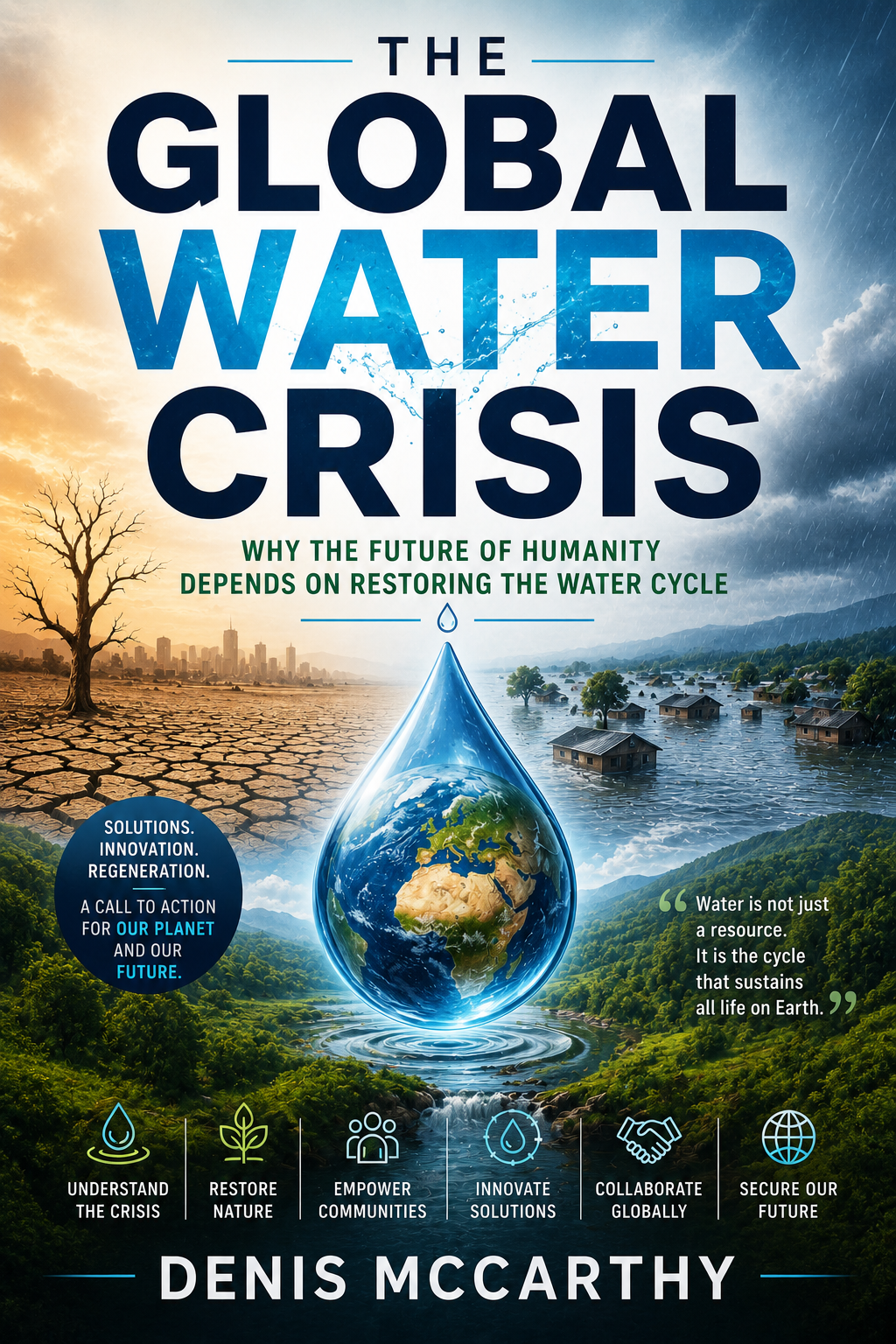
Why the Future of Humanity Depends on Restoring the Water Cycle
By Denis McCarthy
This forthcoming book explores water scarcity, flooding, pollution, ecosystem degradation and disruption of the natural water cycle as interconnected dimensions of one planetary challenge.
Its central perspective is that a durable response to the water crisis requires more than finding additional supplies of water. Humanity also needs to protect and restore the ecological processes through which water moves, is stored, purified and returned through soils, vegetation, rivers, wetlands, groundwater and the atmosphere.
Understanding the global water crisis matters, but Whole Life Times also wants to help connect knowledge with practical action. The Waterless Sanitation Assistance Fund (WSAF) is intended to help worthy communities and humanitarian organisations gain access to sustainable waterless sanitation where conventional sewerage and wastewater systems are impractical, unaffordable or environmentally inappropriate.
Sanitation is inseparable from the water crisis. Conventional flush toilets and centralised wastewater systems can consume large quantities of potable water and require extensive infrastructure, while communities without adequate sanitation may face contamination of soils, rivers, groundwater and local water supplies.
WSAF is intended to become a practical pathway through which readers, donors, organisations, manufacturers, suppliers, logistics partners and humanitarian groups can help make appropriate waterless sanitation available to communities that may otherwise be unable to afford it.
The Fund therefore complements the educational role of Whole Life Times and the forthcoming bookThe Global Water Crisis: understanding the problem, identifying better approaches and helping practical solutions reach places where they can make a real difference.
WSAF Ambassadors can help extend the Fund beyond a website donation page by becoming part of the human network that carries its purpose into communities, organisations and professional circles.
Their role can include raising awareness of the global water and sanitation challenge, introducing the Fund to people and organisations able to help, sharing WSAF projects and educational material, encouraging donations and partnerships, and helping identify communities or humanitarian initiatives that may benefit from practical assistance.
In this way, WSAF Ambassadors become part of the wider Whole Life Universal approach: knowledge leads to connection, connection leads to participation, and participation can help turn concern for the living Earth into practical action.
Gaiarcadia Academy and the Gaiarcadia Summit provide an important meeting place for many of the ideas explored in Environment & Ecology. The inaugural 2024 Summit brought together ecological science, regenerative practice, sustainable settlement and a deeper inquiry into what it means to understand ourselves as part of Gaia.
Gaiarcadia Academy extends these conversations beyond individual events, providing an educational setting in which ecological understanding, human development, systems thinking, sustainability and Gaian consciousness can increasingly be explored together.
Explore GaiarcadiaThe next Gaiarcadia Summit is planned for 16–17 April 2028. As the programme develops, Whole Life Times can follow the people, ideas and emerging themes leading towards this second global gathering and connect them with related material throughout the WLT knowledge field.
Explore Summit 2028Conversations about the living Earth and the transformation in human identity that ecological understanding invites.
Dialogues concerned with protecting and restoring the ecological communities upon which all life depends.
Exploring how ecological restoration can connect with agriculture, settlements, economics, culture and the future of civilisation.